


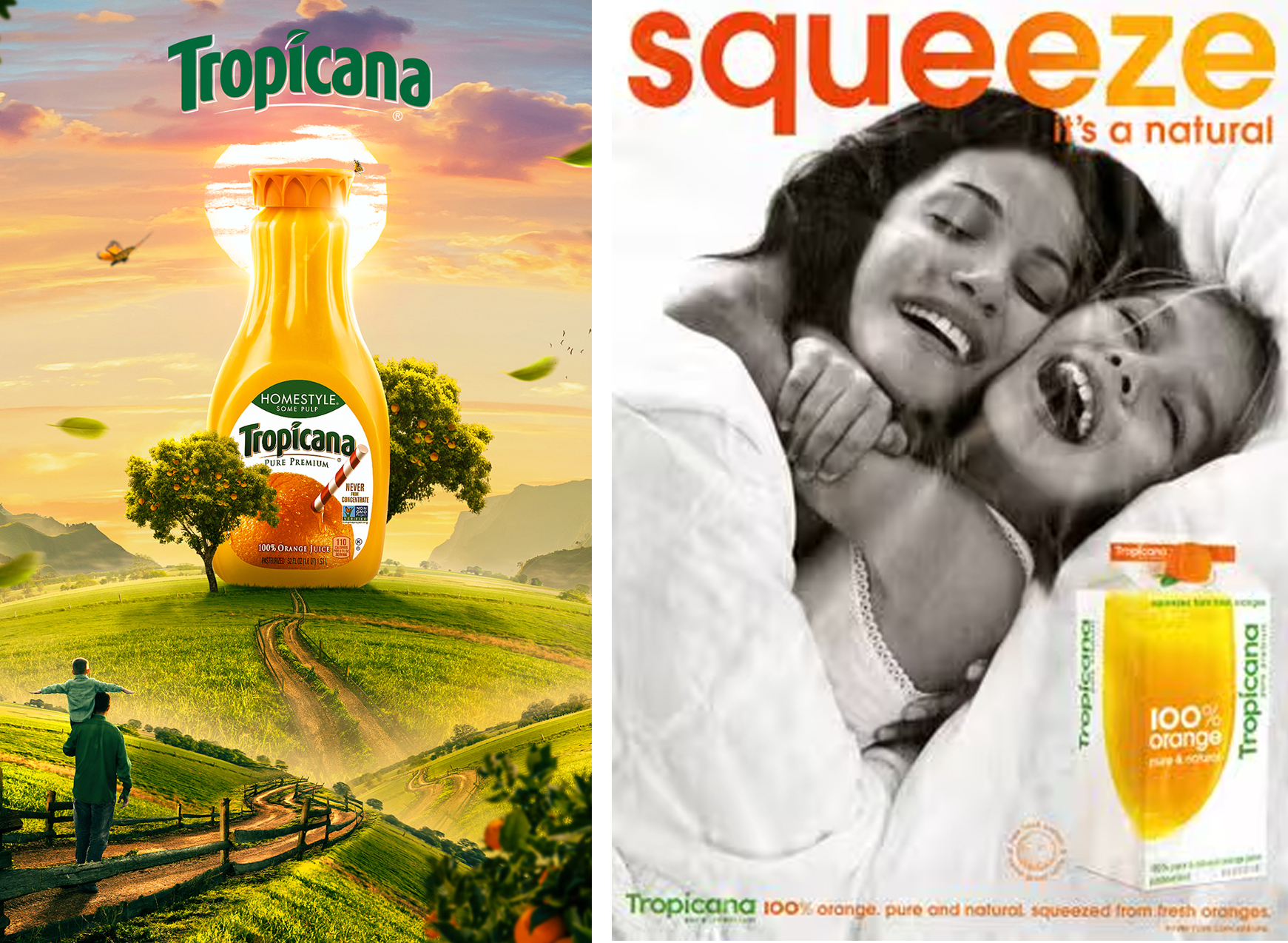
I was fresh out of grad school and counting every dollar. There was exactly one indulgence I allowed myself, a carton of Tropicana. Store brand orange juice was fine, it did the job, but for a couple of bucks more I could buy something that felt like a small act of self-respect. Every morning it made me feel like the version of my life I was working toward had already partly arrived. Two dollars for a little escapism. Cheapest luxury in the world.
So I remember the morning I walked into the grocery store and it was gone.
I stood in front of the juice case and scanned it three times. My first thought was that a company that size does not simply disappear overnight, so I kept looking, and then my eyes landed on a stark, generic carton I had glossed right over. It took me a second to accept that the anonymous thing in front of me was the brand I had been loyal to for years. And my very next thought, standing there in the fluorescent light, was, they are about to lose a fortune.
They did. Sales dropped fast, the redesign got pulled in a matter of weeks, and the old look came back and has stayed ever since. That was 2009. I have been telling this story in classrooms for the better part of two decades, because everything I care about in brand strategy is hiding inside it.
The strategy that misread the moment
Here is the thinking at the time, and a lot has been written about it. The economy was in the floor. The logic went, people are scared, people are pinching pennies, so let us make the package look leaner, cleaner, more generic, because generic reads as cheap and cheap is what people want right now. Court the price shopper.
The problem is that people do not read branding when they are price shopping. They read price tags. That is the whole activity. And the price tag did not move. Tropicana cost exactly what it cost the day before. So the company spent a fortune making a premium product look like a store brand while charging premium money for it, and got the worst of both worlds. It tried to look cheap without actually being cheap.
What they missed is the thing I knew in my own body as a broke twenty-something. Nobody buys name brand orange juice to save money. You buy it for the couple of dollars of feeling that comes with it. That small daily luxury is the entire product. If they had understood that, the recession was an argument to lean harder into the comfort, the warmth, the ritual, the little permission to treat yourself when everything else felt scarce. Instead they stripped the feeling out and left the price in.
Two brands, two worlds
Take the old Tropicana apart and a very specific picture emerges. Health, but health of a particular kind. All natural. It looked like mom reached out the kitchen window, picked the fruit, and squeezed it straight into your glass. Kids drinking juice at a wooden picnic table with green foliage behind them. The famous straw stuck right into the orange. Warm color. Classical serif type with weight and lineage to it. Everything about it was organic, tactile, and close enough to touch.
Now the redesign. Geometric sans serif. Stark black and white photography. Sterile settings, the kind of clean white bed with white sheets you would expect in a wellness ad. The mood was not kitchen. The mood was medicine. It was the visual language of a pharmacy shelf. Honestly, it would have worked beautifully for a vitamin water or a supplement. For a glass of orange juice that is supposed to feel like a hug, it was a category error.
Two brands. Two entirely different worlds of meaning. And the interesting part is not that one was prettier than the other. It is that they were built on opposite ideas about where wellness even lives.
The garden and the expulsion
The old brand occupied an archetype of place I would call the Garden. Wellness as something immanent, embedded in the natural world, familial and abundant and present. Health you can reach out and touch. That is Genesis health, paradise health, the picture of a world where heaven and earth and the body are all connected and pouring life into each other. The straw in the orange is a tiny theological statement. It says the good thing is right here, available, incarnate.
The redesign occupied a different place entirely, and it is worth naming precisely, because it is Neoplatonic. Wellness as an abstraction. Health that lives in a realm of pure geometric form, perfect, sterile, clean, free from corruption. You do not touch it. You ascend toward it. You aspire.
Put those two side by side and you are looking at the expulsion from the garden. The story where longevity and health once grew in the dirt with us, and then we are cast out, and paradise gets relocated somewhere abstract and immaculate and divorced from the natural. I find it fascinating how much of contemporary religious imagination, even inside Christian circles, has quietly absorbed Plato on this point. Heaven stops being a restored earth and becomes a white, weightless, corruption-free elsewhere. Tropicana, without meaning to, walked its customers straight through that exile in a single package redesign.
The dialects of place
Every archetype of place speaks its own visual dialect, and once you learn to hear it you cannot unhear it.
The Garden speaks in organic vocabulary. Curved lines, flowing shapes, warm earth tones, ochres and greens and the orange itself. The signs all point to presence, immediacy, seasonality, cycles, abundance. The serif carries tradition in it, the sense of something handed down across generations of care. Meaning in this space is generated locally, through the senses, through participation. You are inside it.
The Neoplatonic place speaks the opposite dialect. Geometry, clean edges, white and black, high contrast, nothing extra. The signs point to order, transcendence, universal principle, separation. The sans serif is stripped of ornament on purpose, because ornament is particular and this space wants to feel like a law rather than a story. Meaning here is not generated, it is imposed from above. You do not participate in it. You submit to it and observe from a respectful distance.
Which is exactly why the hospital is our culture’s cathedral. Think about it. You are born there and you die there and you are made well there. White walls, white light, everyone in lab coats that hang like vestments, doctors moving through it with the authority of clergy. It is heaven rendered in vinyl flooring. It is also the place where you are most powerless, most dependent on abstract systems you cannot see or understand. That is the Neoplatonic bargain. Perfection, in exchange for surrender.
Tropicana took a product that belonged in the garden and dressed it for the hospital. No wonder loyal customers could not find it. It had been moved to a different plane of being.
Where brands actually live
I want to be honest about what this kind of analysis is, because it sits in a strange and wonderful place. On one side you have cold, mechanical, reductionist deconstruction, the analytical work of taking a sign system apart piece by piece. On the other side you have something deeply personal, and if I am being frank, something spiritual.
I read Baudrillard as a mystic, whatever he might have said about himself. Jung certainly was one, no matter how carefully he wrapped his mysticism in scientific language. That is what drew me to him in the first place, a man doing genuine spiritual practice and then insisting on looking at it through a rigorous lens. This whole Tropicana exercise is, in that spirit, a little act of synchronistic reading. It lives somewhere between science and spirituality, and that in-between is precisely where brands live too.
Because a brand is not an equation. All the data in the world will not tell you why a broke graduate student reaches for one carton over another, since that decision happens in the body, in memory, in feeling, in the quiet mythology a person carries around about who they are becoming. You need the rigor and you need the soul. Choose only the rigor and you get the 2009 redesign, a perfectly reasoned solution to a completely misunderstood human being.
A brand cannot be holistic if the thinking behind it is not holistic. It cannot live purely in the cold, clean, Neoplatonic state of data understanding alone. There has to be an emotional, human, spiritual component, or you end up making orange juice look like medicine and wondering why people stopped drinking it.
This is also why I care so much about reading brands at the level of the collective. When people organize themselves around a brand, the loyalists and the customers and the quiet daily users, they become a kind of organism, a multi-participant body the way any community is a body. That body has a mood. It has an emotional pulse. And you can take its temperature. That is the whole reason I built what I built, to tap into that shared symbolic field, the collective unconscious of an audience, and get a real reading of what is resonating and what is quietly building resistance before you go and print two hundred million cartons of the wrong thing.
Tropicana had that pulse under their hands the entire time. They just were not listening to it.

Thanks for reading.
If you run a company and you don’t know what your pattern is, that’s what my team at DarkSquare does. If you’re an agency and you make patterns for a living, we built Constellations so you can show a client what people actually perceive instead of arguing taste with them.