


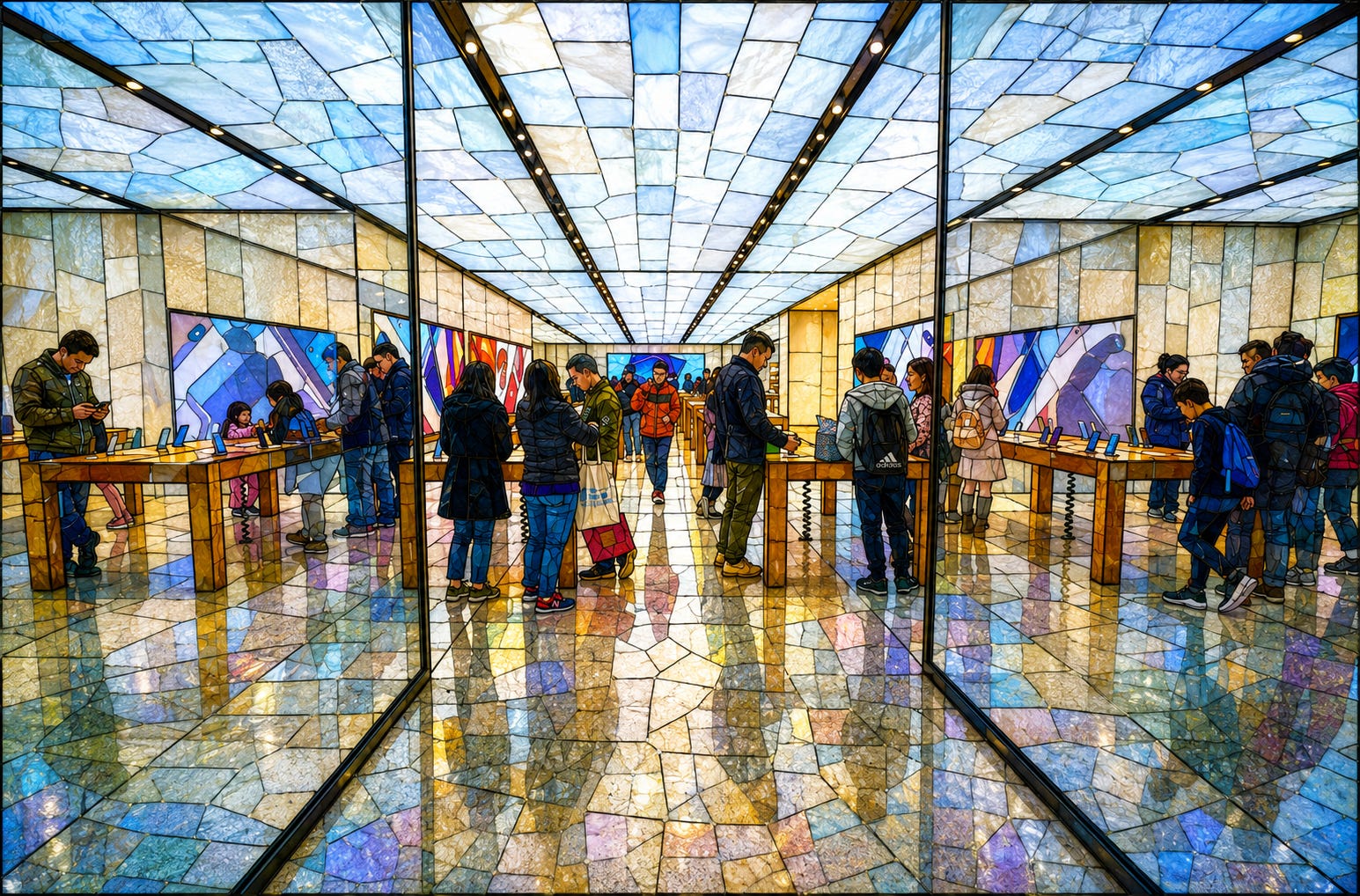
When I moved to Los Angeles after art school, I was living the dream I had signed up for. I went to fine art college to be a starving artist, and I was extremely good at the starving part. I slept in my car. I roughed it in ways I don’t need to catalog here. What I had was a laptop, a portfolio, and a sense that if I could just stay in the conversation, something would eventually happen.
The Apple store was where I stayed in the conversation.
I went for the free WiFi and to check my email, which is a thin and practical reason to go anywhere. But that isn’t why I kept going. I kept going because it was the one room in the city where I could stand next to other design nerds and computer nerds and talk about the thing we all cared about, and nobody asked me for anything. It was warm. It was quiet. It was clean. I was welcome there in a season when I wasn’t particularly welcome anywhere, and I didn’t have to buy a thing to stay.
It took me years to understand what I had actually been walking into. It was a church. Not metaphorically, not loosely. Structurally.
The building tells you before anyone speaks
Start with the threshold. Apple spent enormous money on doors made of glass so precise they read as a single sheet of nothing, and those doors are not a design flourish, they are a rite. You pass through a plane. The street noise drops. The light changes. You are somewhere else now, and your body knows it before your mind catches up. Every sacred architecture in human history begins with this move: a narthex, a gate, a torii, a font. You do not wander into the holy. You cross into it.
Then the floor. Wood. Warm, wide plank, walked smooth. In a building otherwise made of glass, aluminum, and light, the floor is the one surface that touches you back. It is the only material in the room that ages, and it is the material under your feet the entire time.
Then the room itself. Long tables to the left and to the right, running the length of the space, oriented forward. Pews. People sit and stand at them in loose ranks, heads down, reading text off glowing surfaces, occasionally leaning to a neighbor to say something quiet. In the back, raised, a taller table where the ordinary customer does not go. An altar, with a rail. And behind it, backlit, floating on the wall, the logo. Not a sign, not signage in any retail sense, because it does not tell you the store’s name or its hours or what’s on sale. It simply glows in the position that a tabernacle occupies, which is the position where the thing itself is kept.
And moving through all of it, for years, people dressed head to toe in black. Not a uniform in the polo-and-khakis retail sense. A habit. It reads the way clergy reads: this person has set themselves apart, this person is not shopping, this person belongs to the building.
I have never been able to unsee it, and I don’t think anyone can once it’s pointed out.
The absences are as loud as the objects
An anthropological reading of the room pays attention to what is missing, because absence is a choice with a reason behind it.
There is no cash register. There is no counter separating buyer from seller, no transactional chokepoint, no queue to pay. Money changes hands in the aisle, quietly, almost apologetically, out of a pocket. The commerce is real but it is deliberately unceremonious, which is exactly how a collection plate works. You give as you pass. Nobody stops the service for it.
There is no price shouting. No banners, no percentages, no urgency. There are no aisles in the grocery sense, no carts, no signage hierarchy directing traffic. There is very little to read at all.
And the acoustics are wrong for retail. A mall is chaos on purpose, because chaos moves inventory. This room is hushed. Not silent, but hushed, the way a nave is hushed, where you can hear individual voices at conversational volume from thirty feet away and nobody is raising theirs. People modulate themselves without being asked to. That is not a lighting decision or a merchandising decision. That is what a room does to a body when its proportions signal reverence.
The devices are lit from within and set on bare wood with nothing around them. No packaging, no shelf-talkers, no context, no clutter. Just the object, alone, glowing, at a respectful distance from the next object. That is not a display. That is a reliquary. And people touch them the way you touch a relic, with two fingers, carefully, then withdraw.
The intermediaries
The geniuses are the reason the whole thing coheres, and they are the part I find most theologically precise.
They mill around in the nave. They are among the people, not behind glass, not elevated, not hard to reach. They are approachable in exactly the way a parish priest is approachable, which is to say they are clearly set apart and clearly available at the same time. That combination is rare and it is not accidental.
And what they do is triage. You come to them with a broken thing, and this is the part people underrate: you come with a confession. You tell them what you did. You dropped it. You spilled something on it. You ignored the warnings. You did the thing you knew you shouldn’t do, and now the machine is sick, and you are standing in a beautiful room admitting it out loud to a stranger in black who has knowledge you do not have.
They listen. They ask questions before they offer a solution, which is spiritual direction, not sales. And when the case warrants it, they carry your sick machine to the back, up to the altar, into the space where you are not permitted to follow, and there it is either healed and returned to you or pronounced beyond healing.
The asymmetry is real but it is not cruel. You are not being gatekept. You are being ministered to. The knowledge lives up there because it has to live somewhere, and the person who holds it came out to meet you in the pews.
What the room is actually reverent toward
Here is where the reading gets interesting, because everything I’ve described is the architecture of reverence, and reverence is always reverence toward something.
Apple’s values are not hidden. They have never been hidden. Form follows function, yes, and the objects are genuinely beautiful, and the experience of using them is genuinely central to the enterprise. But underneath that is the thing the company has said out loud, on billboards, for decades.
The mark is an apple with a bite taken out of it. Whatever anyone intended, that is the oldest image we have of the first transgression: knowledge obtained by breaking the rule, and the world changed permanently by it.
And then the canon. Think Different put Ali on the wall, and Lennon, and Earhart, and Einstein. Rebels. Troublemakers. Round pegs in square holes. The explicit thesis was that the people who break the frame are the ones who move the species forward, and the implicit theology underneath it is Promethean: transgression is how knowledge is redeemed. The rule was the obstacle. Breaking it was the ascent.
So the reverence in that room is real, but read where it points. It does not point up and out toward something above you. It points in, toward the self that is going to think differently, and toward the knowledge that self will acquire, and toward the tool that makes the acquisition possible. The healing at the altar restores the instrument of your individual ascent. The whole liturgy serves intellectual ascent, and intellectual ascent through going against the grain.
That is a coherent theology. It’s an old one. It predates the company by a few thousand years.
And nobody had to plan it
Rob Janoff has said, plainly and repeatedly, that he put the bite in the apple for scale. Without it, at small sizes, the silhouette reads as a cherry. That’s it. That’s the whole story. No Eden, no Turing, no myth.
I believe him. Completely.
And that, for me, is the entire point.
Because it happened anyway.
Jobs may have sensed some of it. He said things over the years that suggest he was operating close to the archetypal layer on purpose. Janoff, by his own account, was solving a legibility problem on a logo. The store architects were solving for daylight and flow and sightlines. Nobody in that chain was drawing up a nave.
The pattern showed up regardless, in the mark, in the campaign, in the room, in the black clothes, in the position of the altar, all of it agreeing with all of it, because every one of those decisions was made downstream of the same set of values by people executing at a very high level of craft. And when values are that coherent, and the craft is that good, the archetype is not a choice anyone makes. It is a result. It precipitates out.
This is what I think the Apple store is evidence for, and it is a bigger claim than anything about Apple: these patterns are not applied to the work. They emerge from it. Do the work well enough, from convictions clear enough, and you will build a temple whether or not you meant to, and you will not be able to see it, and everyone standing in it will feel it anyway.
I felt it for a year before I understood a word of it. I just knew it was the one room in Los Angeles where I felt like I belonged to something.

Thanks for reading.
If you run a company and you don’t know what your pattern is, that’s what my team at DarkSquare does. If you’re an agency and you make patterns for a living, we built Constellations so you can show a client what people actually perceive instead of arguing taste with them.