


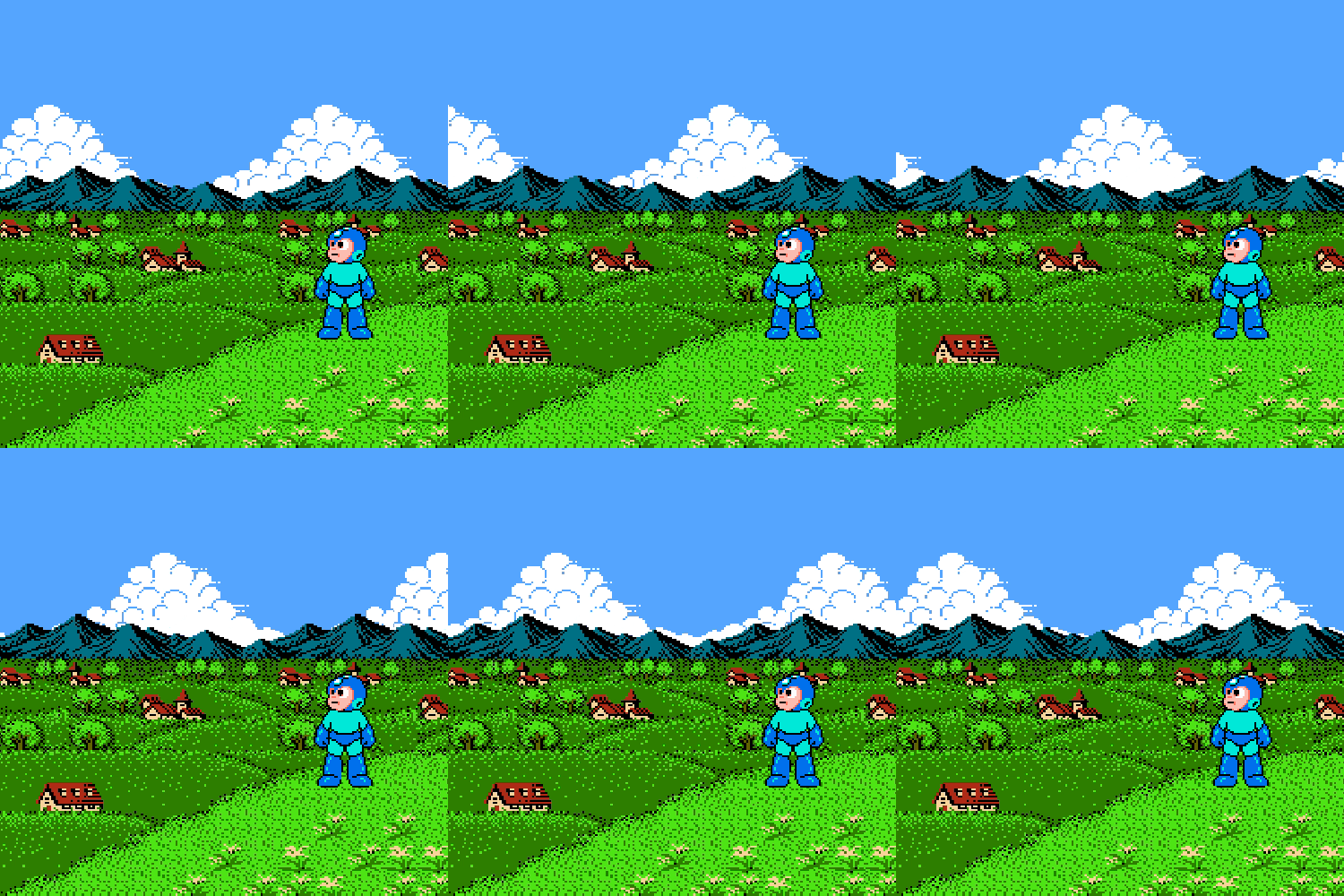
If you weren’t around for it, Mega Man 2 came out in the US for the Nintendo Entertainment System in June 1989. You play as a small blue robot built by a good scientist, Dr. Light, defeating robot bosses and taking their powers as you hunt for the bad scientist who made them, the evil Dr. Wily. Wily has built eight robots to take over the world. You go through them in whatever order you can survive (an approach the series pioneered, based on the old rock, paper, scissors game), you take each one’s weapon when it falls, and then you go after him. That was enough of a premise, because the game was beautiful, the levels were cruel in a way you could learn, and the music is arguably the best to ever come out of a game franchise.
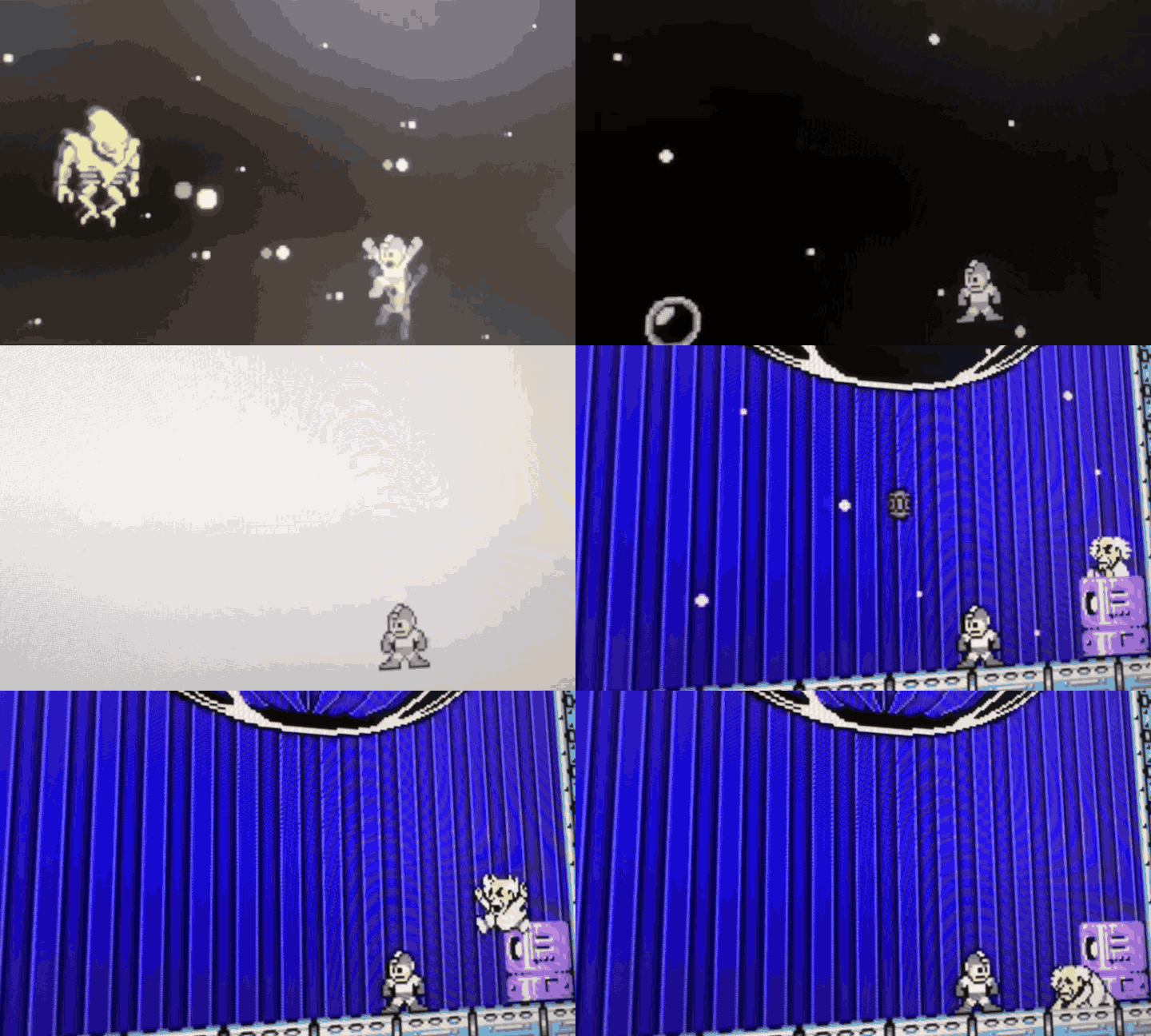
Towards the end of the game, after a grueling series of fights with Wily flying some contraption back and forth over your head shooting at you, and a careful walk through a creepy, silent cavern (the sound design in this game was second to none), you find yourself in the last room. It’s dark. There’s no floor or walls you can see, and stars fly by in the background like you’re hurtling through space. Then he levitates out of his craft and changes into something otherworldly. I was literally shocked to see him transform into an extraterrestrial, green and glowing, right before my 9-year-old eyes.
I was sitting on the carpet about three feet from the screen and I could not believe it. The mad scientist I had been chasing all game was not a man. Every robot I’d fought, the whole fortress, all that technology, there was an answer behind it, and the answer was that none of it had come from here. The game had turned over in my hands and become a different game, a different story entirely.
Then you beat it. The music cuts out and the sound of a broken machine buzzes at you. The lights come up, and there’s Wily, behind a control panel at the edge of the room, like a DJ when the bar turns the house lights on, a little projector still floating around the room where the extraterrestrial was just a moment before. He’d been there the whole time. He drops to his knees and begs Mega Man for mercy. The ending music starts, and the game moves into a closing sequence that people still describe as one of the most emotional and reflective sequences produced for the NES. After the ups and downs, the intensity of the play, and a dozen levels spent chasing a man who turned out to be something else and then turned out to be a man, the ending lands hard on a kid, not even 10 years old, who has never once thought about what’s real, what isn’t, and what any of it means.
I believed one thing, found out I was wrong, then found out I’d been right from the start, and the whole thing took about ninety seconds. For a kid on a carpet in 1989 that was a lot to wrap my head around. The world got pulled apart and put back together in the same shape.
It probably sounds dramatic to talk about an old 8-bit video game like it was some kind of timeless novel or classic film, but I’ve thought about that room a lot over the years, and since generative AI showed up, a lot more.
We’re in a long public argument about whether the images and videos in front of us are real or generated. Deepfakes, fabricated events, convincing pictures of things that never happened. Those are real concerns. But the argument rests on an assumption that deserves a harder look.
We have been confusing representations of reality with reality itself for a long time. AI didn’t start that. There’s a slim chance it ends it.
Nothing Changed. Everything Changed.
The interesting thing about the extraterrestrial projection in the Mega Man game is how much it changed everything without changing anything at all. AI is doing the same thing to us right now, which is why I’m writing this.
Before the creature showed up, Wily was a familiar kind of villain. He built machines, wanted the world, and kept losing to the hero. The creature handed me a new explanation for all of it. The robots were the work of something from off the planet. The fortress was stranger than I’d thought. Even Wily’s reasons looked different. The same events now belonged to a different story, and when the projection shut off, all of those relationships moved again.
We tend to think of knowledge or data as a pile. We find a new fact, add it to the pile, and the picture gets a little more complete. Meaning doesn’t work that way. Sometimes one piece of information reorganizes everything attached to it. A detail that seemed like nothing becomes the whole point. Something you feared turns out to be harmless. Someone you trusted starts to look suspicious. The facts sit exactly where they were. What moved is your understanding of how they connect, and the emotional side of that is not small.
I was astonished when Wily turned out to be an extraterrestrial. Somehow I was even more astonished when he didn’t. Both reactions were to interpretations of a fictional event, and one of those interpretations was false even inside the fiction. The feelings were real anyway, and under them there’s a second layer that’s so obvious it’s easy to miss its importance. Dr. Wily obviously wasn’t real either. Neither was Mega Man, or the fortress, or the creature, or the floor, or the Bubble Lead (the most unlikely but only weapon effective against the extraterrestrial) that rolled across the screen. Sprites on a cartridge, sixteen colors and a sound chip, a simulation with another simulation running inside it. Yet inside that world I could still tell truth from deception. I could believe something false, catch the trick, and land on a more accurate account of what had happened in the game and story.
I found out the truth about something that never existed.
The Simulacrum Is True
“The simulacrum is true.” Baudrillard famously borrows the line from Ecclesiastes. Except he doesn’t. Ecclesiastes never says it. He wrote it himself and attributed it to King Solomon and, through biblical connection, God Himself, and the rest of the epigraph says the simulacrum is never what hides the truth. It is the truth that hides the fact that there is none. A made-up quotation borrowing the authority of scripture, about images borrowing the authority of the real.
The part of the idea I need is small. A simulacrum is a copy with no original behind it, an image that points at nothing, and the claim is that we live among them without noticing, because they look exactly like images that point at something.
Wily’s projection isn’t quite that. There was a truth behind it, and the game showed me. But look at what the exposure did. It didn’t just tell me the creature was light. It told me the room had a projector in it, that the fortress had been wired for this, that the man at the console had been willing to do it. The suspicion ran backward over everything I’d seen.
That is the lens I want for deepfakes. Images were never real. Not the photograph, not the broadcast, not the feed. We set AI images against them, call the AI ones fake, and in the same breath call the others real, which they never were. What the epigraph means, as far as I can tell, is that catching the simulacrum doesn’t reveal a truth hiding behind it. It reveals that there was none in the image to begin with. The AI fake casts doubt on every image on the screen, and every image on the screen should have carried that doubt all along.
The Camera Became a Witness
People have been making pictures of things that never existed for as long as there have been people. Imaginary landscapes, mythical animals, long accounts of events that never happened. We also worked out ways to judge them. Who made this, what else do they say, who else saw it.
Photography, in 1839, changed the terms. A painter could invent a landscape. A photographer, as a rule, had to stand in front of one. Light bounced off a real thing and landed on a plate, and the picture seemed to carry its own proof. The camera became a witness, and that status stuck. Journalism, courts, science, passports. A photograph became evidence that what it appeared to say was so.
The manipulation of images made with this new method was immediate and inherent, as it is with every made image. Nineteenth-century photographers staged scenes, combined negatives, retouched prints, and sold pictures of ghosts. The camera could record what was put in front of it. It could not tell you whether the scene was honest, whether the caption was fair, or whether the meaning you took from it was an honest understanding of it.
That’s the quiet confusion that has been with us since. A camera can faithfully record a scene that was built to mislead. The politician among supporters who were bused in for the morning. The family that was happy for one sixtieth of a second. The product under the right lights. Even an unstaged photo is a position, a moment, and a frame, chosen from a thousand that weren’t published. Everything outside the frame stays unknown.
Film and video inherited all of it and added motion, which reads as even more trustworthy. The internet inherited that and added speed. A picture or a clip now arrives stripped of its source, its date, and whatever was around it, shared by someone who got it from someone, and lands on a feed next to things that are true.
Photography gave us an extraordinarily fast and detailed way to document the physical world. It gave us an equally good way to manufacture impressions of it. Those two capabilities have always come as a set.
Generative AI is the same situation with the volume up. It is a better way than we have ever had to explore, model, and represent the world with depth and fidelity, and a better way to deceive with it. The camera on steroids. What I’m grateful for is that people understood the second half immediately. Nobody needed a decade of ghost photographs to work out that a render can lie. The hope is that the same people notice the images they were already indulging as real were never held to that standard. AI is doing to the screen what the projector did to the room.
Nothing New Under the Sun
We have already conceded, many times over, that a photographic image on a screen isn’t to be trusted on sight. Staged scenes, combined negatives, retouched prints, the airbrush, the Photoshop clone stamp, and finally a verb for it, shopped, which is how you know a thing has become ordinary. To say a picture is shopped is to say a photograph existed and somebody altered it.
Generative AI takes the photograph out of the sentence. You can now produce a convincing photograph of a subject without ever photographing the subject. A person appears somewhere they have never been. A public figure says something they never said. An event is shown in full detail and never occurred. There’s nothing to have shopped, because there was never a plate for the light to land on.
The consequences are serious. Provenance matters enormously when the question is whether something happened. But the public conversation keeps collapsing two questions into one.
How was this image made?
Is what this image says true?
Baudrillard has a move that fits here. Disneyland, he says, is presented as imaginary so that we’ll believe the rest is real. The admitted fake sits inside the city and does a job. It points outward at the suburbs and the freeways and says, that out there is the real country, when the whole of it runs on the same logic. The park is the alibi.
AI images are lined up to play the same part. Every image we can tag as synthetic becomes the park, and every image we can’t becomes the real country by default. That’s the crossroads. We can take the epigraph at its word, that the simulacrum is true, that images were never the real, and start reading all of them accordingly. Or we can keep pointing at the render and saying, that one’s fake, and go on being deceived by everything we didn’t point at. The second is easier, and it’s the one we’re building the tools for.
A cereal ad shot on a built set with hired actors, and the same ad typed into a generator, are nearly the same picture. They carry the same idealized family, and neither is a true account of anybody’s morning. The camera’s presence didn’t make the first one honest.
Which is the extraterrestrial in Mega Man all over again. The question that mattered in that room was never whether the thing in front of me was made of light. It was what I had decided it meant, and what I’d rebuilt around that decision.
So the popular split between real and AI-generated is getting less useful by the month. The better split is between an image’s authenticity as a record and the truth of what we take from it. You have to check both, and the first has never settled the second.
Generative AI didn’t bring deception into pictures. It broke an assumption we had built up about the link between looking like a photograph and having happened. That assumption was always a bad bet. It just paid out often enough that we stopped noticing it was a bet. We can no longer infer that a thing occurred because the picture has the texture of a photo, which puts us back in front of a much older problem, with a new fake on hand to blame for it.
The House Lights
I’d like to say I’m optimistic about this. Short term, I’m not. The transition is going to be rough, and most of the damage will land on people who never read a word of French theory. Deepfakes will manufacture evidence, wreck reputations, and move elections, at a pace traditional media never could, but make no mistake, traditional media has always done these things. Long term I’m more hopeful, for a reason that has nothing to do with the technology.
For far too long we have used the camera as a shortcut to certainty. Looks like a photo, so it happened, so it’s true. Generative AI decisively broke the shortcut. Maybe that forces us to handle images with the care we should have been using all along. Who made this, why, what does it show, what did it leave out, and what besides the picture supports the reading I’m being handed. Those questions work the same on a photograph and on a render.
Baudrillard would be skeptical that exposing one illusion produces clarity. His whole point is that simulations get so embedded that catching one just drops you into the next, and the new deception runs cover for the old one. He’d have a case. We could build very good systems for certifying that an image came out of a camera or a render and then keep swallowing whatever the certified images mean. New York now requires advertisers to disclose when a model in an ad is “synthetic.” It solves nothing new. It’s a bad answer to an old problem we already had a decent set of laws and habits for handling, and it leaves the actual question, whether the ad is telling you the truth about the product, exactly where it was. A detector that tells you a picture was AI-generated rather than taken on a phone tells you nothing about whether to believe it. We could get excellent at spotting synthetic content and not one bit better at reading pictures. That’s a real possibility, and it would be a waste.
Because the pictures don’t just describe the world. They push on it. Advertising shapes what we want. Social media sets what we expect of ourselves and each other. Political imagery teaches us what a leader is supposed to look like. Pictures of idealized bodies change how we see our own. We draw a picture of the world and then start renovating the world to match the picture. I don’t think that loop makes truth unreachable. It makes interpretation the job.
When the lights came on in that room I hadn’t escaped the game. I’d understood something inside it. The discovery didn’t take anything away from the experience. It finished it. Same facts, same story, and now I knew about the trick that had briefly rearranged what all of it meant.
We’re doing that now, at scale. We’ve found out that a photograph’s or video’s look can be produced without the event it looks like, and we’re starting to question images we would have waved through. We never should have waved them through. Trusting a digital image can be reasonable, in the company of a trustworthy source, some critical thinking, and the tools we’ve always used to tell true from false. And you can learn deep and true things from manufactured images, from abstraction, from fiction, from a video game about a blue robot. We shouldn’t lose that. We would just be wise not to confuse the media with the physical, the picture with the thing.

Thanks for reading.
If you run a company and you don’t know what your pattern is, that’s what my team at DarkSquare does. If you’re an agency and you make patterns for a living, we built Constellations so you can show a client what people actually perceive instead of arguing taste with them.